

Schaibley named inaugural faculty fellow to unify quantum research at U of A
The University of Arizona Office of Research and Partnerships named John Schaibley, associate professor of physics, as its first Faculty Fellow for Quantum, a new position designed to guide the university’s growing efforts in quantum science and technology.
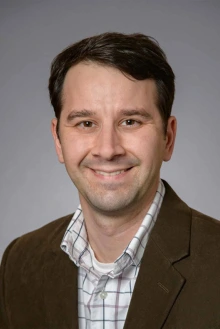
John Schaibley is associate professor of physics at the U of A College of Science
Photo courtesy of John Schaibley
Over the next three years, Schaibley will serve as an advisor to Tomás Díaz de la Rubia, senior vice president for research, to organize, strengthen and expand the U of A’s quantum research ecosystem.
“Our strength lies in the expertise of researchers across disciplines and the partnerships we’re building with industry,” Díaz de la Rubia said. “By unifying our quantum efforts, we can position Arizona as a national leader in a technology space that will shape the future — enabling breakthroughs in areas such as semiconductor manufacturing, secure communications and AI.”
Schaibley’s primary goal as faculty fellow is to bring together U of A researchers across campus to create a united, centralized quantum initiative. He will establish a framework for leadership to advance quantum research that spans colleges and fosters collaborative innovation.
“This is about how we hire and grow quantum strategically at the University of Arizona in a way that will make us excel in a unique way,” Schaibley said.
Beginning in January 2026, he will launch a strategic planning process and lead a series of workshops across campus. Faculty members who are working in any area related to quantum will be invited to share ideas and identify opportunities to design a long-term vision for the university’s endeavors in the field.
“We want to identify a central group of researchers to come up with a quantum game plan that reflects the U of A’s unique strengths and aligns with national and global priorities,” Schaibley said.
The U of A is particularly well-positioned to explore new quantum frontiers due to its strengths in advanced materials, acoustics, optics and space science. These strengths include U of A’s Center for Semiconductor Manufacturing where Schaibley serves as a Fellow and the New Frontiers of Sound (NewFoS) NSF Center that leverages advanced acoustic technologies that mimic quantum phenomena.
Quantum research will also tremendously benefit from the newly renovated ACA-funded Nano Fabrication Center, which enables the fabrication of state-of-the-art quantum devices. The U of A’s existing research in fusion energy – the process that powers the stars – provides another opportunity for applied quantum technologies that could also help model safe, sustainable and virtually limitless energy sources on Earth.
“This is the perfect time for us to take our quantum efforts to the next level, given the national interest in quantum technology, semiconductor manufacturing, AI and fusion energy,” Schaibley said. “This is a prime opportunity to engage with quantum computing companies to apply these systems to challenges in AI and fusion energy.”
Schaibley pointed to the National Quantum Initiative Act, which was signed into law in 2018, as the impetus for an explosion of quantum startup companies representing billions of dollars of investments. Those companies represent collaboration and research opportunities and can open doors for the development of new quantum computing, communications and sensing technologies, he said.
Schaibley sees strong potential for future quantum applications specifically in quantum photonics and space.
“There are natural connections on campus between our strengths in quantum, advanced semiconductor manufacturing, optics, acoustics and space sciences. I am going to encourage collaborations that will develop next-generation quantum devices and explore space-based quantum systems.”
Schaibley is also advancing his own quantum research. He recently received the Gordon and Betty Moore Foundation Experimental Physics Investigator Award, a five-year, $1.3 million grant. With the Moore Foundation support, Schaibley’s lab will engineer new quantum states in 2-D semiconductor devices and further develop synthetic quantum materials, based on artificial crystals constructed at the nanoscale to control how electrons move and interact. These patterned materials can be designed to exhibit exotic behaviors like superconductivity and magnetism, potentially leading to new fundamental discoveries in condensed matter physics.
If applied, this work could one day enable faster, more energy-efficient computers that could reduce the energy footprint of massive data centers or be applied to AI/machine learning and data security applications.
“By the end of my three-year fellowship, I want to have increased the activity of quantum research on campus by unifying the people already here, hiring new faculty, winning collaborative university-wide research grants and partnering with businesses to translate new quantum technologies to industry,” Schaibley said.
Expert
John Schaibley, PhD
Associate Professor, Department of Physics, College of Science
Associate Professor, Wyant College of Optical Sciences